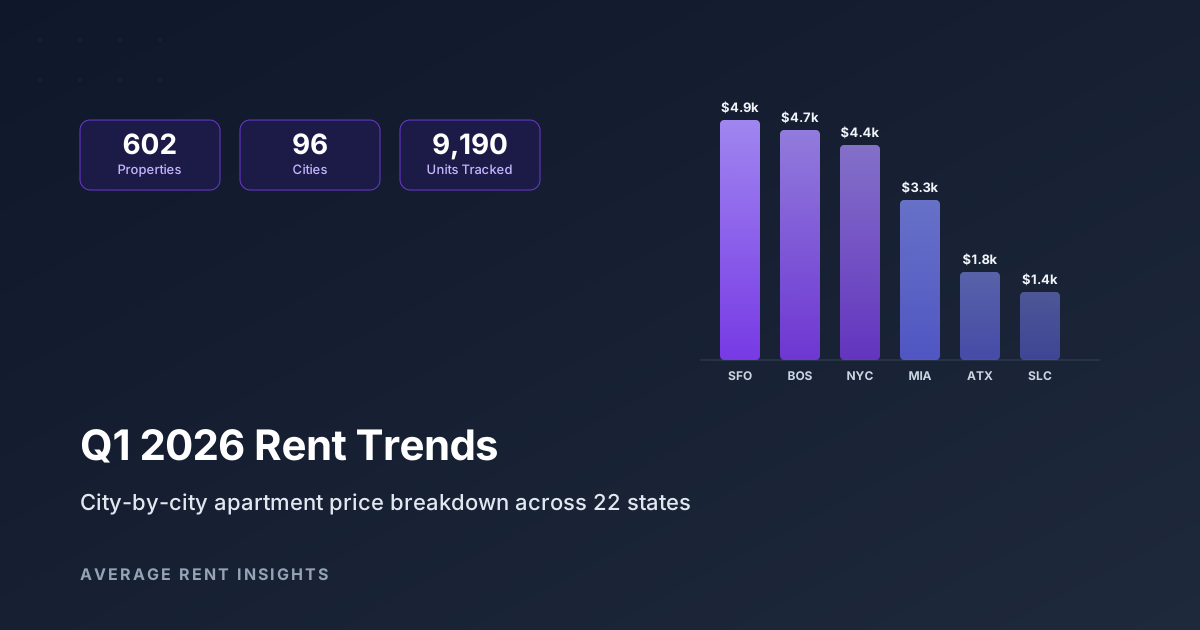
Q1 2026 is done. We tracked 602 apartment properties across 96 cities in 22 states, covering 9,190 individual rental units. Every number in this report comes from live asking prices collected through our proprietary data sourcing. No surveys. No estimates.
This is the first quarterly report where our dataset covers enough of the US to draw cross-market comparisons. Here’s what we found.
The big picture: $2,110 average, wide spread
The average asking rent across all tracked units in April 2026 is $2,110/month. But that single number hides enormous variation. The cheapest unit in our database rents for $600/month (a studio in Salt Lake City or Washington state). The most expensive hits $15,000/month (luxury inventory in California and Arizona).
Where the bulk of the market sits:
The price distribution peaks in the $1,400-$2,000 range, where 3,178 units (34.6% of our total) cluster. Here’s how the full distribution breaks down:
| Price Range | Units | Share |
|---|---|---|
| Under $1,000 | 54 | 0.6% |
| $1,000-$1,400 | 796 | 8.7% |
| $1,400-$2,000 | 3,178 | 34.6% |
| $2,000-$3,000 | 2,654 | 28.9% |
| $3,000-$4,000 | 869 | 9.5% |
| $4,000-$5,000 | 414 | 4.5% |
| $5,000+ | 225 | 2.4% |
This is a market with a fat middle and a long luxury tail. If you’re shopping in the $1,400-$2,000 band, you have the most competition but also the most options.
State rankings: Massachusetts to Iowa
We now track properties in 22 states. The state-level averages reveal a 6x gap between the most and least expensive markets.
Top 5 most expensive states:
| State | Properties | Avg Rent | Price Range |
|---|---|---|---|
| DC | 1 | $6,954 | $3,781-$9,979 |
| Massachusetts | 5 | $4,704 | $2,000-$8,125 |
| New York | 4 | $3,968 | $1,000-$8,969 |
| Virginia | 6 | $3,400 | $1,652-$13,800 |
| California | 67 | $3,106 | $750-$15,000 |
Top 5 cheapest states:
| State | Properties | Avg Rent | Price Range |
|---|---|---|---|
| Iowa | 26 | $1,131 | $695-$1,650 |
| Utah | 4 | $1,390 | $600-$2,129 |
| Pennsylvania | 1 | $1,500 | $1,500 |
| Missouri | 5 | $1,685 | $1,020-$3,375 |
| North Carolina | 58 | $1,843 | $999-$10,000 |
Iowa ($1,131) entered our database in April 2026 with 26 properties across 17 small cities managed by Kading Properties. These are townhome-style communities in places like Osceola, Boone, and Cherokee where rents run 45-65% below the national average.
Texas dominates by volume: 213 properties, more than triple the second-place state (California at 67). Despite that scale, Texas rents average $1,989, below the national figure.
City rankings: San Francisco to Osceola
Individual cities tell a sharper story than state averages.
10 most expensive cities (min. 3 tracked properties):
| City | State | Properties | Avg Rent |
|---|---|---|---|
| San Francisco | CA | 3 | $4,869 |
| Boston | MA | 5 | $4,704 |
| Brooklyn | NY | 3 | $4,437 |
| Fremont | CA | 5 | $3,700 |
| Long Beach | CA | 5 | $3,479 |
| Oakland | CA | 5 | $3,416 |
| Irvine | CA | 5 | $3,412 |
| Arlington | VA | 6 | $3,400 |
| Miami | FL | 14 | $3,281 |
| St. Petersburg | FL | 6 | $3,196 |
California takes five of the top ten spots. The Bay Area (SF, Fremont, Oakland) averages $3,995 across its tracked properties.
10 cheapest cities (min. 3 tracked properties):
| City | State | Properties | Avg Rent |
|---|---|---|---|
| Osceola | IA | 3 | $1,040 |
| Boone | IA | 4 | $1,171 |
| Salt Lake City | UT | 4 | $1,390 |
| Raleigh | NC | 9 | $1,613 |
| Cary | NC | 16 | $1,622 |
| Jacksonville | FL | 3 | $1,657 |
| Kansas City | MO | 5 | $1,685 |
| Katy | TX | 8 | $1,685 |
| Morrisville | NC | 12 | $1,703 |
| Austin | TX | 101 | $1,769 |
The North Carolina Triangle (Raleigh, Cary, Morrisville) places three cities in the cheapest ten. Combined, these markets offer 37 tracked properties averaging $1,646, roughly one-third of San Francisco pricing. For remote workers choosing where to live, the Triangle is one of the best value plays in the eastern US.
Bedroom breakdown: studios are not the cheapest option
Conventional wisdom says studios cost less than 1-bedrooms. Our data disagrees.
| Unit Type | Units | Avg Rent | Cheapest | Most Expensive |
|---|---|---|---|---|
| Studio | 1,835 | $2,287 | $600 | $15,000 |
| 1-Bedroom | 4,206 | $2,037 | $788 | $6,775 |
| 2-Bedroom | 2,739 | $2,585 | $695 | $12,995 |
| 3-Bedroom | 425 | $2,893 | $755 | $12,029 |
Studios average $250/month MORE than 1-bedrooms nationwide. The reason: studios concentrate in premium urban cores (downtown SF, downtown Austin, Manhattan-adjacent Brooklyn) where per-square-foot pricing is highest. Suburban markets add more 1-bedroom inventory at lower price points, pulling the 1-bedroom average down.
The practical takeaway: if you’re price-sensitive, look at 1-bedrooms before studios. You’ll get more space for less money in most markets.
Austin, TX: 101 properties, 18 neighborhoods
Austin is our deepest market with 101 tracked properties and 1,753 individual units. It’s also one of the most affordable major metros in the Sun Belt.
Austin by bedroom type:
| Unit Type | Units | Avg Rent | Cheapest | Most Expensive |
|---|---|---|---|---|
| Studio | 239 | $1,492 | $750 | $7,500 |
| 1-Bedroom | 884 | $1,690 | $788 | $3,647 |
| 2-Bedroom | 533 | $1,979 | $869 | $5,044 |
| 3-Bedroom | 93 | $2,017 | $1,009 | $5,365 |
In Austin, studios DO cost less than 1-bedrooms ($1,492 vs $1,690), unlike the national pattern. Austin’s studio inventory includes a healthy mix of suburban and urban buildings, so the premium-core bias doesn’t dominate.
Austin neighborhoods ranked by average rent:
The spread within Austin is striking. Downtown commands $2,457/month while neighborhoods a few miles south rent for under $1,300.
| Neighborhood | Properties | Avg Rent | Cheapest |
|---|---|---|---|
| Downtown | 8 | $2,457 | $750 |
| Mueller North | 2 | $2,395 | $1,349 |
| Old West Austin | 5 | $2,134 | $750 |
| Mueller | 9 | $2,123 | $999 |
| Downtown South | 9 | $2,094 | $828 |
| Rosewood | 4 | $1,983 | $1,066 |
| Holly | 7 | $1,962 | $1,171 |
| East Riverside | 5 | $1,808 | $795 |
| Hancock | 4 | $1,701 | $1,099 |
| Robinson Ranch | 5 | $1,660 | $936 |
| Barton Hills | 4 | $1,524 | $1,099 |
| SW Austin | 3 | $1,520 | $1,071 |
| Slaughter Creek | 6 | $1,510 | $1,100 |
| Gateway | 8 | $1,474 | $934 |
| Bluff Springs | 7 | $1,408 | $799 |
| Franklin Park | 6 | $1,286 | $750 |
| South Lamar | 5 | $1,259 | $819 |
| Greater South River City | 4 | $1,136 | $831 |
Downtown to Greater South River City: $1,321/month difference. That’s $15,852/year for what might be a 15-minute drive.
The Mueller area (Mueller + Mueller North) averages $2,175 across 11 properties. This planned community near the old airport maintains premium pricing because of its walkability, green spaces, and retail mix.
South Austin neighborhoods (Slaughter Creek, Gateway, Bluff Springs, Franklin Park) cluster around $1,400-$1,510 and represent the best value for renters who don’t need downtown access.
Denver, CO: 41 properties, premium pricing
Denver runs 25-77% more expensive than Austin depending on unit size.
Denver by bedroom type:
| Unit Type | Units | Avg Rent | Cheapest | Most Expensive |
|---|---|---|---|---|
| Studio | 163 | $1,765 | $972 | $11,100 |
| 1-Bedroom | 357 | $2,174 | $1,194 | $3,367 |
| 2-Bedroom | 190 | $2,880 | $1,440 | $4,713 |
| 3-Bedroom | 2 | $3,564 | $3,167 | $3,960 |
Denver vs Austin side by side:
| Unit Type | Austin | Denver | Denver Premium |
|---|---|---|---|
| Studio | $1,492 | $1,765 | +$273 (+18%) |
| 1-Bedroom | $1,690 | $2,174 | +$484 (+29%) |
| 2-Bedroom | $1,979 | $2,880 | +$901 (+46%) |
| 3-Bedroom | $2,017 | $3,564 | +$1,547 (+77%) |
Denver’s premium grows sharply with unit size. Studios cost 18% more, but 3-bedrooms cost 77% more. Families and roommate groups feel the Denver tax hardest.
Denver’s floor price is also higher: the cheapest studio in Denver ($972) costs $222 more than Austin’s cheapest ($750). The cheapest 1-bedroom gap is even wider: $1,194 vs $788, a $406/month difference.
Capitol Hill and the urban core held prices through Q1. Suburban developments along I-25 priced to fill vacancies, with 2-bedrooms running $200-$300/month below comparable urban units.
Florida: Miami vs the Gulf Coast
Florida’s 45 tracked properties split between expensive coastal markets and more affordable alternatives.
Miami (14 properties, $3,281 avg) prices 2x higher than Jacksonville (3 properties, $1,657 avg). St. Petersburg (6 properties, $3,196) runs nearly as expensive as Miami despite being a smaller metro.
Florida’s statewide range is massive: $1,000 to $11,500. The state offers both luxury waterfront living and workforce-priced inventory, but they occupy very different zip codes.
North Carolina: the value play
North Carolina has emerged as a key market in our dataset with 58 tracked properties. The Triangle area dominates.
| City | Properties | Avg Rent |
|---|---|---|
| Raleigh | 9 | $1,613 |
| Cary | 16 | $1,622 |
| Morrisville | 12 | $1,703 |
| Durham | 6 | $1,844 |
| Charlotte | 11 | $2,111 |
Cary offers the best combination of inventory depth (16 properties) and affordable pricing ($1,622 avg) in the state. Charlotte runs 30% higher than the Triangle cities, reflecting its larger metro economy and financial sector demand.
Q2 outlook
Two factors to watch heading into Q2 2026:
-
Summer migration. College graduation season and job relocations drive May-August demand. Expect asking prices to firm up starting mid-April across Sun Belt markets.
-
New construction absorption. Several large developments are finishing lease-up phases in Austin, Denver, and the Triangle. If those buildings fill slower than projected, you’ll see more promotional offers and concessions. Late June is a good time to negotiate: Q2 quarter-end falls during peak moving season, so managers who need to hit occupancy targets may cut deals.
We’ll publish the Q2 report in July with a full quarter of trend data behind it.
How we track this
Average Rent refreshes asking prices each morning through our proprietary data sourcing. We track every unit in every building we cover, so we catch daily price movements that monthly surveys miss. Explore rent trends on the interactive map or start tracking your target market.
Methodology: All figures are based on live asking prices collected through our proprietary data sourcing as of April 2026. Database covers 602 properties with 9,190 individual units across 96 cities in 22 states. Prices reflect listed asking rents, not negotiated or effective rents. City-level rankings require a minimum of 3 tracked properties to reduce sampling noise. Updated daily.